When I was a young girl I would watch, with fascination, my great-grandfather eat his dinner. This German immigrant, who grew up in poverty and deprivation in central Europe, licked his plate so clean, as family members said, it didn’t need to be washed. Even in this new country, where food was plentiful, he wouldn’t waste one bit of precious food.
It’s occurred to me that I’m part of the last generation whose ancestors—both grandparents and great-grandparents —were part of a mass migration in the early 20th century from central Europe, spurred by poverty and a search for a new and more promising life.
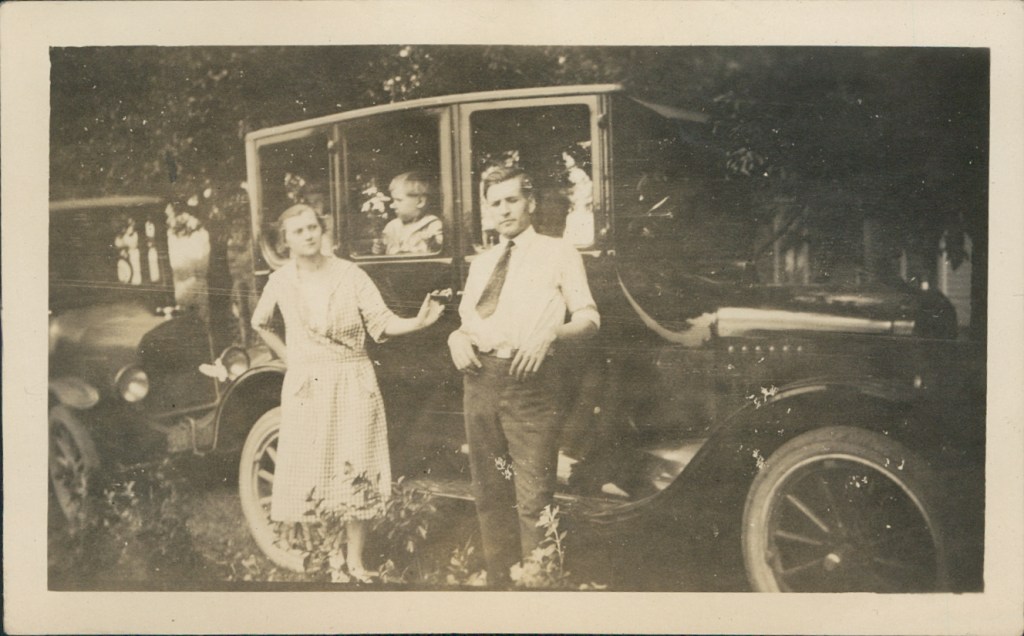
The son-in-law of my great-grandfather, my German grandfather (above, with my grandmother), came to this country at the age of 16 with $15 in his pocket, leaving behind his family, including parents who he never saw again. I know little of his life in what was then the Austro-Hungarian Empire, except that his family were peasants who farmed common fields outside of town and kept domestic animals in the rear of their house. There was no indoor plumbing, and I imagine life was hard and food was scarce.
For reasons I don’t know, my grandfather was able to escape this harsh life and find work in the nearest town as an apprentice to a tool-and-die maker. Did his parents scrape together enough money to send him there? In any case, he was fortunate to have a skill that would get him a job in America, because otherwise he would have faced the same fate as his four brothers who were all killed in World War I.
And where did he find the money to board a ship to America, the land of promise in the early 20th century? Where did he find the courage to leave his family and embark on a solitary journey to a place he had only heard stories about? What teenager in this culture and time could do anything like that?
My grandfather was able to establish a thriving business in Chicago that provided enough money for his three sons, including my father, to support large Catholic families. He and my grandmother lived frugally in a small apartment; his only indulgence was cars. Yet they managed to set aside college funds for their 28 grandchildren.
Both sets of grandparents survived the economic depression of the 1930s, but even into the 1950s and 1960s, when food was more plentiful and life was easier, they never forgot the hard times. I remember going to my Czech grandmother’s house and finding bottles of small objects she had saved for another possible bout of hardship, including small pieces of string that could be tied together if needed.
Today, recent immigrants from Mexico and other Latin and South American countries who have experienced their own hardships can appreciate the wealth of this country. But succeeding generations of my family and others whose ancestors came from the old country have no contact with the old ways, with the old generation that survived World War I, the Depression and World War II, who lived so close to the bone and never took for granted an easy life.
Succeeding generations don’t know, or only know through their history books, their ancestors’ lives of deprivation. They are far removed from the lives of their great-great-grandparents. Their parents or grandparents might share the stories they know, but it’s like history—long ago and not that interesting.
Thanks to my grandparents and their struggles to build stable lives, they were able to pass on the little wealth they had to their children and grandchildren. I’ve lived a comfortable life, with enough food to eat and always a roof over my head. And yet the whisper of my grandparents’ lives haunts me.
When I consider a new car or clothes, a friend will urge me on: You can afford it. But the ghost of my grandparents and great-grandparents won’t allow it. I know of their suffering and their lives of simplicity, of never living beyond their means, of their generosity in wanting to make sure the next generation was taken care of. In respect for my grandfather’s courageous journey to a new world and my grandparents’ frugal lives, I won’t allow myself to use the money that I inherited from them for anything frivolous.
In their honor and thanks to them, I live my life in moderation, owning the same car until it breaks down, wearing the same clothes until they’re unwearable, rejecting anything that seems unnecessary or extravagant. I think they would have been proud of me, just as I am proud of them—my ancestors who bravely endured hardships that most Americans can hardly imagine.


You’re right–we’re the last of the generation who heard stories from their grandparents about their parents and what their lives were like. My father told stories of traveling from Indiana to Georgia in the 20s to pick cotton, all the kids riding in the open bed of a pickup truck. Grandma made bathtub gin–literally–she made gin in a bathtub that sat out back of their house, and she jugged it and sold it. I did not learn frugality. Just stubborn that way, I guess. But I am very aware of how rich my life is. I am grateful. Thank you for these memories, Kath.
LikeLike
You describe what, as an adoptee, I didn’t have. I was adopted at birth. There were stories about my adoptive parents’ English and Irish ancestors, including, it was said, a pirate named “Bloody Joe Jeffrey.” I’ve led a pretty privileged life, given to me by generous, loving parents and four wonderful siblings. No complaints or regrets whatsoever.
LikeLiked by 1 person
Thank you for pointing out that not everyone has a biological family. But I’m glad to hear you had a good life with loving parents and siblings.
LikeLike
My Father was a child of the depression. He never got over it. He was a collector of everything. I’m surprised the city didn’t make him clean his yard. It was a major eye sore and a mess. But he paid my way into school. That was the end of his support. I went away for a job with less than $20 in my pocket. I went hungry and lived on the street at night until I got that first pay check. I can clearly see that I am not like most people. I too am very frugal.
LikeLike
Frank, living on the street and going hungry is a true hardship. It sounds like that taught you to be frugal.
LikeLiked by 1 person
Very interesting, thoughtful and thought-provoking essay, Kathy. Makes me think about my own ancestors and their spunk and bravery.
LikeLike
Thanks, Reed. I think most of our ancestors have more bravery than we do.
LikeLike
Very beautiful text, thank you, Kathy. Poverty and hardship exist everywhere, even if you never left the country where you and the whole of your family and ancestors were born and lived their whole lives.
Europe suffered two long wars that brought poverty, and the fascist political regimes that prolifferated until the end of the 20th century, also created unequality. Although I lived in cities, I was able to chop wood and light the fire in the oven, I could prepare food for the chickens, i knew how to wash clothes by hand and how to iron. I could sew the hem of a skirt or to sew buttons in clothes. ALL this before I was 10 years old!! I hated it (except chopping wood or feed the chickens!). At 10 I went to boarding school but never lost the skills.
LikeLike
I envy you the skills you learned as a young girl. As the oldest of seven children, I learned how to take care of my siblings but never how to chop wood. How will the next generations know how to take care of themselves?
LikeLike
they will, if they have to! It is a question of survival:-) What astonishes me the most is how was it possible that my parents and other grown ups allowed me to use an ax!!! I must say I loved to do it!believe it or not:-)
LikeLike
They must have really trusted you.
LikeLike