Lessons From My Grandparents

When I was a young girl I would watch, with fascination, my great-grandfather eat his dinner. This German immigrant, who grew up in poverty and deprivation in central Europe, licked his plate so clean, as family members said, it didn’t need to be washed. Even in this new country, where food was plentiful, he wouldn’t waste one bit of precious food.

It’s occurred to me that I’m part of the last generation whose ancestors—both grandparents and great-grandparents —were part of a mass migration in the early 20th century from central Europe, spurred by poverty and a search for a new and more promising life.

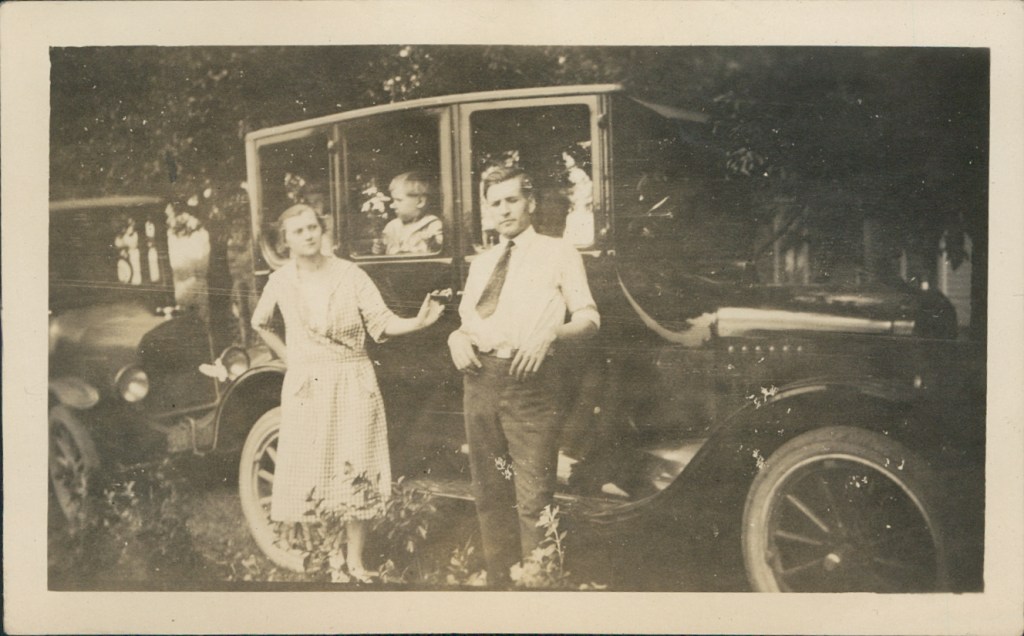
The son-in-law of my great-grandfather, my German grandfather (above, with my grandmother), came to this country at the age of 16 with $15 in his pocket, leaving behind his family, including parents who he never saw again. I know little of his life in what was then the Austro-Hungarian Empire, except that his family were peasants who farmed common fields outside of town and kept domestic animals in the rear of their house. There was no indoor plumbing, and I imagine life was hard and food was scarce.

For reasons I don’t know, my grandfather was able to escape this harsh life and find work in the nearest town as an apprentice to a tool-and-die maker. Did his parents scrape together enough money to send him there? In any case, he was fortunate to have a skill that would get him a job in America, because otherwise he would have faced the same fate as his four brothers who were all killed in World War I.

And where did he find the money to board a ship to America, the land of promise in the early 20th century? Where did he find the courage to leave his family and embark on a solitary journey to a place he had only heard stories about? What teenager in this culture and time could do anything like that?

My grandfather was able to establish a thriving business in Chicago that provided enough money for his three sons, including my father, to support large Catholic families. He and my grandmother lived frugally in a small apartment; his only indulgence was cars. Yet they managed to set aside college funds for their 28 grandchildren.

Both sets of grandparents survived the economic depression of the 1930s, but even into the 1950s and 1960s, when food was more plentiful and life was easier, they never forgot the hard times. I remember going to my Czech grandmother’s house and finding bottles of small objects she had saved for another possible bout of hardship, including small pieces of string that could be tied together if needed.

Today, recent immigrants from Mexico and other Latin and South American countries who have experienced their own hardships can appreciate the wealth of this country. But succeeding generations of my family and others whose ancestors came from the old country have no contact with the old ways, with the old generation that survived World War I, the Depression and World War II, who lived so close to the bone and never took for granted an easy life.

Succeeding generations don’t know, or only know through their history books, their ancestors’ lives of deprivation. They are far removed from the lives of their great-great-grandparents. Their parents or grandparents might share the stories they know, but it’s like history—long ago and not that interesting.  

Thanks to my grandparents and their struggles to build stable lives, they were able to pass on the little wealth they had to their children and grandchildren. I’ve lived a comfortable life, with enough food to eat and always a roof over my head. And yet the whisper of my grandparents’ lives haunts me.

When I consider a new car or clothes, a friend will urge me on: You can afford it. But the ghost of my grandparents and great-grandparents won’t allow it. I know of their suffering and their lives of simplicity, of never living beyond their means, of their generosity in wanting to make sure the next generation was taken care of. In respect for my grandfather’s courageous journey to a new world and my grandparents’ frugal lives, I won’t allow myself to use the money that I inherited from them for anything frivolous.

In their honor and thanks to them, I live my life in moderation, owning the same car until it breaks down, wearing the same clothes until they’re unwearable, rejecting anything that seems unnecessary or extravagant. I think they would have been proud of me, just as I am proud of them—my ancestors who bravely endured hardships that most Americans can hardly imagine.

I Come to Praise Technology

Recently, my hometown installed a new method of payment in the parking garages. When you leave, you flash your cell phone with the QR app, linked to your credit card, at the kiosk. This replaces a perfectly good system where you inserted your credit card into the machine to pay.

I’ve had trouble with QR codes since they were introduced during the pandemic to replace menus in restaurants. Many times I’ve had to ask my dining companions to share the menus on their phone or beg the waitstaff for a paper copy, which is often out of date. In any case it doesn’t make for a leisurely perusal of the menu.

As hard as I try, I feel like I’m always several steps behind the latest technology, floundering at the cash register or parking garage, giving every indication that I have early dementia—or worse, that I’m an old lady. Yet I have to admit that technology has helped me and fellow seniors cope with the afflictions of getting older. It’s made life easier in so many ways. I think of my partially blind friend who can ask Siri to put on her favorite music or dial someone on the phone.

The technology I’m most grateful for is Google Maps. Because of my poor sense of direction, I’d be lost, quite literally, without it. Otherwise, I would have to write down detailed directions or else strain to read the small print on old maps that don’t include new subdivision. (And just try to find new maps.) Once in the Chicago area, driving my elderly parents to my niece’s house, my cell phone stopped working, and I had to stop at numerous stores along the way to find my way on all the crazy numbered highways (“Just go to 52, get on 23, then get off on 71”). We arrived about an hour late.

As we become more isolated as we age (friends die, children move away), a social media platform like Facebook can reconnect us with high school friends, former co-workers and the sister-in-law you lost touch with after she and your brother divorced. You can feel like you’re part of a larger community. I think of the elder orphans group on Facebook where people who don’t have children share stories of loneliness but also advice for how to meet people. It doesn’t take the place of personal connection, but it can be more meaningful than sitting home alone talking to your cat.

Similarly, for those unable (because of physical problems) or unwilling (because of snowy roads) to leave the house, Zoom (and other video conference programs) lets people meet and converse with others. It’s not the same as sitting in a room together, but online we can discuss the current political situation or hear lectures about arthritis.

I don’t know how I lived without Spotify. Not only can I easily find my favorite music, the music service pretty quickly figures out what I like and puts together playlists that also introduce me to similar musical artists. I can find my old favorites from the 1970s without thumbing through my scratched and worn record albums or the chewed-up cassette tapes. I can follow my curiosity about current popular musicians without having to buy their albums. 

With the internet, I no longer have to rely on my (faulty) memory to make favorite meals: do I use lentils or pinto beans for that soup recipe? I admit it’s a pleasure looking through my old cookbooks stained with flour or cherry juice, and with penciled notes for changes I made in the recipe, but the internet is faster.

I no longer have to depend on my memory or my doctor’s (especially when I have six specialists) for my medical history. Many documents and tests—when I had my last mammogram or colonoscopy—are stored online. And it’s all connected in some unseen network, so when I see my primary care provider, she has the x-rays, lab results and notes from another doctor. Of course, I also miss the days when one doctor had all our files, and a friendly receptionist was always available to answer questions. But those days are long past.

With the internet, I don’t have to thumb through an old phone book to find the name of a restaurant or find a plumber, and I can see how each is rated. If I want to find the best time of the day to take a walk, I can get the weather forecast hour by hour. When I’m planning a vacation I can find lists of lodgings—and reviews— on websites and make a reservation rather than comb through an old guidebook that recommends only three or four places—often no longer in business.

There’s no doubt that aging makes driving more difficult, whether due to less flexibility or focus. But with rear-view cameras we don’t have to turn our less-flexible necks to see if someone is behind us in a parking lot.

Now I’m looking forward to reliable self-driving cars. Hopefully by the time I have to give up driving, these cars will compensate for my poor sense of direction and concentration. Siri, take me home.

You Can’t Go Home Again

In this world of too much change and chaos, I’m constantly looking for something stable, something from my past that I could return to and be comforted, like my childhood neighborhood. But everything is gone now, because, at my age, I have little connection to the home I grew up in. My parents are long gone, and only one neighbor (the mother of my childhood best friend, age 99!) still lives on the old street.

Of course, the neighborhood has changed in the 60 years since I grew up there. It’s become wealthier with bigger houses and fewer children. Although the small shopping center a block from my childhood home still exists, nothing is left except for the grocery store where I briefly worked.  Everything else is gone: Huebinger’s Drug Store where my girlfriends and I would buy comic books; the Gift Box, where we would agonize over which stuffed animal to buy with our babysitting money; and nearby the library that was my refuge.

There’s another refuge from my past that I want to go back to: a lake in Wisconsin where I spent the happiest days of my childhood with my family: swimming, boating and reading under the birch and pine trees. Although the family cottage still exists, the lake has changed: bigger homes, less wilderness and louder boats. What was once a clear lake is now filled with weeds, and all the development has chased away the chipmunks and frogs.

Even my beloved places in the Colorado mountains are disappearing. Wildfires have destroyed some of my favorite trails, and old mining towns that had stayed much the same for 100 years are now filled with condos and new mansions. 

There was a time when things didn’t change as quickly. Both sets of grandparents lived in the same neighborhoods in Chicago for their whole lives—one in the Czech neighborhood on the west side and the other on the north and German side. My grandfathers worked the same jobs for their whole lives, while my grandmothers shopped at the same grocery and department stores. Each couple (and their families) attended the same neighborhood church, where they were married, their children baptized and their funerals held. Because they lived in the same place their whole lives, they knew all their neighbors, who also rarely moved. And so a community was formed—at that time (the 1930s-50s) composed mostly of people from their own ethnic backgrounds. Of course, this resulted in an ethnic insularity that often kept out people of different backgrounds and races.

Even though I’ve lived in the same neighborhood for more than 30 years, everyone around me keeps moving, so there are only two houses in a three-block neighborhood where I know the residents. It’s a disorienting feeling, and I think contributes to our sense of anxiety in this world. Along Colorado’s booming Front Range, new subdivisions are taking over once empty fields. Nothing stays the same, especially the landscape.

Even something as small as losing my favorite restaurants can disrupt my personal landscape. Especially during the pandemic many restaurants closed permanently. Though that may seem trivial or unimportant, especially compared to more serious issues like failing health, it’s a loss in our day-to-day lives. You lose a place that you’ve been going to for 25 years—a place that felt comfortable, where you celebrated birthdays or anniversaries, where the chicken pot pie always made you feel better. When other long-time stores and restaurants close, the losses start piling up and one day you realize that all your favorite places are gone. At the new places, the music is too loud, the menu has food you’ve never heard of, the chairs are metal, and everyone there is 30 years younger than you.

It adds to the sense of dislocation, of a world that is out of control. It’s especially hard for seniors because we adapt to change more slowly. All I want is the booth at my once-favorite hamburger joint, but Tom’s Tavern has since been replaced by an upscale restaurant that serves “wood roasted octopus, with curried carrot purée, candied bacon, roasted turnips, asparagus, black garlic aioli.” Since Tom’s closed I’ve become mostly a vegetarian, but if the tavern were magically resurrected, I’d beat a path to their door to enjoy their hamburgers and fries, while sitting in a booth and watching the shuffleboard players. Just for a while, it would feel like home.

Blog at WordPress.com.

Up ↑