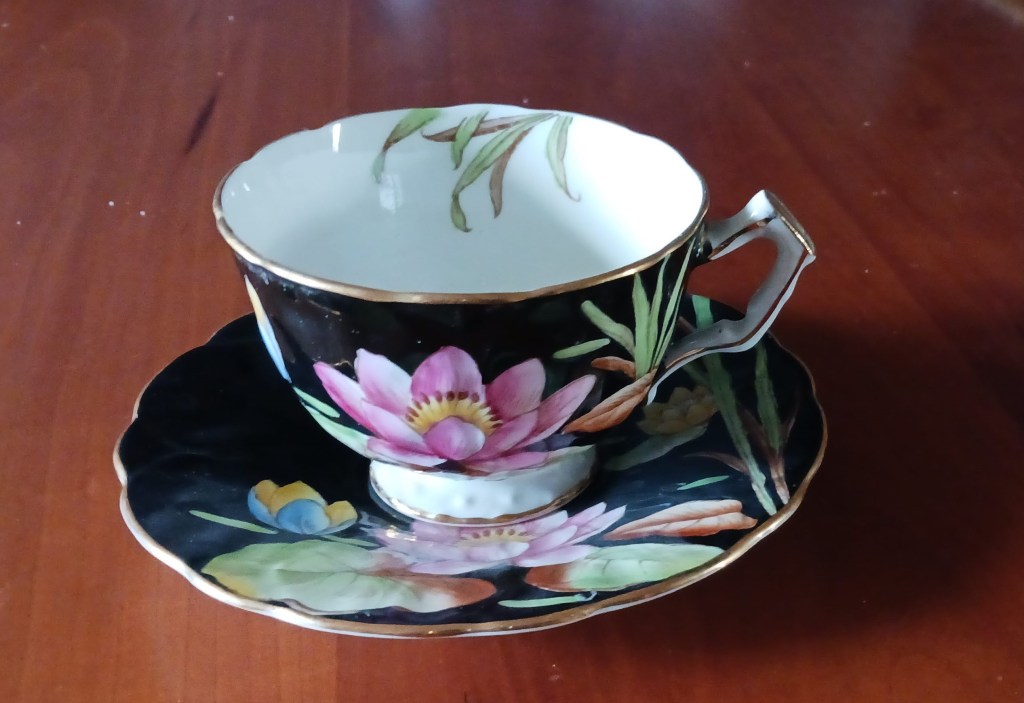
Take This Teacup—Please

I’m not here to offer advice about decluttering, like “if you haven’t worn that shirt in more than a year, get rid of it.” I’m here to admit that my clutter is a result of avoiding making decisions for decades about what to keep and what to get rid of. It’s been easy because I’ve been in the same house for 30 years, a house big enough to stuff my belongings in the back of a closet or a room in the basement and forget about it. I’m paying for it now.

In going through old folders (that is, paper folders), I’m finding paycheck receipts for jobs I had 20 years ago and coupons that expired more than two years ago. Those are the easy things to get rid of because I can toss the papers in my recycling bin. It’s harder when I want to be socially responsible and not add to ever-growing landfills: clothes that maybe someone else can wear (even if they are 20 years out of fashion), winter boots that the homeless could use, or books that someone else might want to read.

Continue reading “Take This Teacup—Please”

Voting Old

In the analyses of the recent election, many commentators noted that young voters helped Democrats win, especially in close races. It shouldn’t be surprising because research has shown that younger adults tend to be more liberal and vote Democratic while older folks are more conservative and vote Republican.

Yet it’s hard to grasp because I had assumed that my generation of baby boomers would carry our liberal politics into old age. We were the generation that opposed the Vietnam War, supported civil and women’s rights and started the first Earth Day celebrations.

In my (adopted) hometown, I remember in my 20s seeing that tidal wave of change. A city council that consisted of white men was replaced with two women, an environmentalist, a black man and a gay man. At the time it seemed revolutionary. Yet somehow those young voters who threw the old white guys out are now getting more conservative. How does this happen?

Research shows that as we age, we process information slower. I was shocked to read that our mental capabilities peak in our 20s and head downhill since then. However, even though we might not be as smart as our younger selves or the younger generation, I was glad to read that we compensate with wisdom accumulated over decades.

Continue reading “Voting Old”

Getting Lost

Several years ago, I was visiting friends in one of the new suburbs southeast of my home, which looked like all the other new subdivisions, with the same winding streets and cul-de-sacs and houses built with the same template.  When I left, it was dark and I wandered among confusing and dead-end streets a long time before I admitted defeat. When I turned on Google Maps, I found I was driving in the wrong direction, and that the exit out of this maze was only a few blocks west.

During the day, I know north from south because the Rocky Mountains are always west, and even if I’m unfamiliar with the neighborhood, I know that if I keep driving north (or south, depending where I’m at), I’ll find my way home. It’s a whole other story if I’m on the western side of the Rockies, so everything is backwards, or if I’m someplace where there are no mountains, or if it’s dark.

I’m not alone in losing my bearings as I age. A study done by a German research institute that compared younger and older drivers found that the younger people did better in navigating. The researchers found “an association between decreased navigational performance and deficits in grid cell activity,” according to the Science Daily article. Grid cells, specialized neurons in the brain that aid in navigation, fired differently in young and older adults.

“Specifically, firing patterns were less stable over time in older individuals, which indicates that these brain circuits are compromised in old age. This might be a cause of why many senior people tend to have troubles with spatial navigation,” according to Prof. Thomas Wolbers, who supervised the 2018 study.

 When my dad was in his late 80s or early 90s, he got lost easily. Fortunately, my mom, who hated driving, was able to direct him to the grocery store or to their favorite restaurant. But one time, my father insisted on going by himself to meet my brother for a golf game. He got so badly lost, heading west instead of north, that it took days for the police to find his car after he abandoned it and walked to a nearby hardware store.

I have yet to get lost on such a grand scale, but I sometimes delude myself into thinking that I know better than Google and ignore its instructions, only to wind up in even more unfamiliar territory. I’ve never had a good spatial sense and yet I can convince myself that the park where I’m meeting a friend is down this street, only to wander for too long, muttering “it’s got to be here somewhere.” I’m unwilling to admit that Google knows more about my neck of the woods than I do. Google usually proves my delusions wrong, although not always.

There’s another reason I get lost. The area where I live is growing so fast that familiar markers are no longer there. The gas station and furniture store have been replaced by new condos; the field where I saw hawks flying is now a Wal-Mart; a sleek modern house now dominates the corner where an old Victorian house sat for more than 50 years. These changes are disorienting, especially when I’ve lived in the same place so long and the landscape is imprinted in my brain, so what I see when I’m on the road is not the map inside my head.

If I didn’t have Google Maps to turn to, I would have to get careful directions from friends I’m visiting or from the store I’m trying to get to. Or I would have to pull out an old map and trace the roads, just like a friend of mine who doesn’t own a cell phone. Once in the chaos of Chicago’s northern suburbs, I couldn’t get my phone to work at all, so I had to stop at stores and gas stations along the way to ask how to get to Hwy. 120 or which direction was Libertyville. Maybe in the end, all we can depend upon is the kindness of strangers.

Kathy Kaiser

Blog at WordPress.com.

Up ↑